
I’ve been chatting to a vegan on the Happy Guide blog for a few days, and as usual, the debate gets quite intense, vegans are certainly passionate about their choices.
Vegan diets untenable
I want to say something about this because basically, my view is that vegan diets are essentially dangerous. My reasons include “big picture” stuff like…
- Homo genus has been eating animal foods for 2.5 MILLION YEARS.
- Eating animal foods is what MADE US HUMAN, e.g. availability of long-chain omega-3 needed for our brain development.
- Traditional cultures and hunter-gatherers highly valued certain animal foods and would often spend a huge time/effort to get them, especially known to be needed for healthy pregnancy. Tradition is not something to be sniffed at. Healthy behaviors get built into culture over thousands of generations based on observations about “what works.” Science can now dissect these behaviors to understand the mechanisms e.g. cooking with onions reduces formation of heterocyclic amines, cod liver oil, fish eggs, fermented foods and organ meats have micronutrients that are very healthy… omega-3 DHA, preformed vitamin A, vitamin D, vitamin K2… this is cutting edge science that was always there in healthy traditions.
- Our gut physiology clearly shows adaptation to higher nutrient density foods available from animals.
- Archaeological evidence from early humans that clearly show diets based primarily on hunting, e.g. cro-magnon in France.
- Study of modern-day hunter gatherers and their diets.
- There are no examples of vegan cultures where vegan diets maintained healthy populations over generations, not now, not ever in history.
- Nutrition is an emerging science, and science is what you do when you don’t know what you’re doing. We don’t know it all yet.
- Testimony of long-term health failure on vegan diets.
… as well as the micronutrient evidence like…
- Our partial need for dietary taurine shows evidence of adaptation to animal foods.
- Some people need dietary cholesterol and don’t make enough of their own.
- Poor conversion in the body of plant-based omega-3 into DHA.
- Healthy balance of omega-3 and 6, essential to prevent chronic inflammation is not possible on a vegan diet.
- Poor conversion of carotenoids to retinoids (vitamin A).
- B12 is only found in animal foods. Vegan B12 status has been found to be very poor in studies. B12 is essential for heart health, involved in pathways with homocysteine that is a risk factor for heart-disease. B12 also needed for healthy myelin sheath that protects nerves, and many other processes in the body. Inadequate dietary sulfur amino acids (methionine and cysteine), and glycine needed for methylation.
- Thyroid problems from excess plant goitrogens including soy but also many other plant foods.
- Inadequate zinc, B6, choline and fat-soluble vitamins A, D, and K2
- Selenocysteine, an animal-based form of selenium is safer at high levels than the plant form selenomethionine, which can cause selenium poisoning.
The poor conversion of plant forms of micronutrients is evidence of adaptation to animal sources of these nutrients that are in the form we need. Click here to read a nice article by Denise Minger about some of these poor conversion issues.
… as well as the macronutrient/food evidence like…
- Lack of high quality, highly absorbable protein. This is one reason why sedentary women do best for longer on vegan diets, their protein needs are very low. Vegan men often use large amounts of protein powder, a highly industrialized process where the cost to nature is hidden. Protein powder is missing all the healthy cofactors found in natural protein sources. Protein is absorbed and utilized by the body depending on the source. Animal proteins have a higher biological value, more is absorbed, so grams of vegetable protein does not equal grams of animal protein.
- Reliance on grains (unnatural for humans) which cause a whole cascade of problems in the long-term.
- A high carbohydrate diet is a main factor in insulin resistance and inflammation, a primary cause of many diseases, including heart-disease.
… as well as insights into the real cost to nature of our diets…
- A grain based diet is a tragedy for nature and the environment. If land is cleared for planting monocrops, then all the life, the complex ecosystem that was there, is gone forever, until it is returned to nature or a polyculture way of producing food crops that mimic nature. Harvesting grains kills mammals and nesting birds. These are just a couple of examples. There is no death-free food (see book recommendation below). If we care about LIFE, then we need to produce food in harmony with natural ecosystems. Permaculture is good to research. I remember chimpanzee researcher Jane Goodall saying that when she first went to Africa, the rivers were overflowing with life, a situation that has sadly changed in such a short time. Abundant LIFE as natural ecology is the humane and sane future, not veganism.
Vegan pillars have shaky foundations
Two of the main arguments used by vegans are The China Study and Dean Ornish’s lifestyle intervention studies showing reversal of atherosclerosis of near vegan diets, very low fat.
China Study — fatally flawed
The China Study was a massive epidemiological i.e. observational study in China where people’s diets were analyzed against health outcomes. A book was written by lead author Colin Campbell based on his conclusions of the China Study, that animal protein causes disease.
This is not how science is done, this is not the scientific method, that has been developed so as to avoid wrong conclusions so easy to come to if we’re not careful.
Epidemiology is good for creating hypothesis, an idea of possible causation, but cannot show causation itself, further study involving ideally double-blind clinical trials are needed to attempt a first step in teasing out the cause-effect. Attempt is made to isolate a variable while keeping all others constant to test the effect of that single variable.
Clever science bods have recently looked at Campbell’s work and found it to be full of holes, bias, selective interpretation of data based of his personal agenda, and frankly, shoddy science. Here’s an enlightening chat between Dr. Mercola and Chris Masterjohn about how Campbell’s work is fatally flawed. It’s in 4 parts, I recommend watching the whole thing if you are a China Study believer…
The China Study, analyzed objectively actually shows meat consumption to be neutral for health outcomes, fish to be protective, but WHEAT to be incredibly strongly correlated with disease, the strongest correlation of all. If you’d like to dig deeper into the flawed science of The China Study, here’s some good places to start…
http://www.proteinpower.com/drmike/cancer/the-china-study-vs-the-china-study/
http://rawfoodsos.com/the-china-study/
http://www.cholesterol-and-health.com/China-Study.html
Dean Ornish lifestyle intervention
The other main pillar of veganism is Dean Ornish’s lifestyle intervention study which was the first to prove that lifestyle could reverse heart disease. I think in terms of understanding the power of lifestyle, Dean Ornish has us done a huge service, but in my view, a couple of things need to be clear…
- A diet to reverse a certain condition is NOT necessarily a diet that will maintain health of a population over generations, or prevent the disease in the first place. Fasting also has a tremendous record of healing, but it won’t maintain your health for long :-)
- The mechanism behind Ornish program was not understood, there were MANY factors in his study including smoking cessation, exercise, meditation etc. Until the mechanism, the causes are understood, it is not scientific or even humane, to recommend a diet without understanding the full implications. Since Ornish’s early work, atherosclerosis HAS been reversed on even HIGH FAT diets. So, it seems to be the process of weight normalization, insulin control etc that are the true causes, i.e. NOT vegan low fat.
So, the pillars of veganism are so shaky, and only hold up at all due to the momentum gained from popular exposure to flawed science like the China Study book, and EARLY intervention studies like the work of Dean Ornish. All in all, vegan diets in my view have no basis for recommendation whatsoever, and are frankly dangerous.
Vegan health failures
I regularly come across accounts of health failure on vegan diets. The book recommendation below “The Vegetarian Myth” (author 20 years vegan) is a detailed account, and I recently came across another book called “The Meat Fix” (author 26 years vegan) about long-term health failure and recovery by eating animal foods. Interestingly, the author reports being able to throw away his glasses after a while on his new carbohydrate-controlled, animal foods based diet.
Here’s a very interesting account by Dr. Chris Masterjohn about his journey into vegetarianism, and veganism spurred on by reading “A Diet for a New America” by John Robbins. Then his subsequent worsening dental problems, irregular heartbeats and panic attacks, and finally his return to health using nutrient dense animal foods. Anxiety, panic attacks, poor libido, dry skin, tooth decay and digestive problems are the most common issues I see reported, and the length of time it takes for these to manifest varies depending on the health of the person in the beginning, and the choices made while vegan. Here’s Chris’s story:
http://www.cholesterol-and-health.com/Vegetarianism.html
Here’s an excellent page of vegan failures (including Gandhi) and reasons by the Natural Hygiene Society, previously advocates of veganism…
http://naturalhygienesociety.org/diet3.html
E.g…
Kevin Gianni, “Renegade Health”: What diet do you eat now Kevin?
“At one point I was taking 6-10 vegan supplements a day to attempt to override my deficiencies – B complex, DHA, Vitamin D, B12, a mineral supplement, protein powder, chlorella, and more. I also adjusted my diet to add more cooked foods to see if that would change the way I felt as well. This was over a 2 year period. ….. After the introduction of goat’s kefir and yogurt, I immediately felt an increase of energy, slept better and many issues started to clear up – my acne started to disappear, my knees stopped aching after a run, I gained back weight lost, I was able to retain muscle mass better, I could get out of bed in the morning, etc.”
Brain damage
“By far the most intractably damaged brains and nervous systems I have ever encountered have to the letter been vegetarians and especially vegans.” — Nora Gedgaudas, Primal Body, Primal Mind. Click for excellent video.
Vegetarianism is do-able if you can tolerate dairy
(not recommended, but less damaging than veganism)
The compassion, desire for health, and to do the right thing for the planet are noble ideals, ones I can relate to (although I definitely question the idea that veganism, or vegetarianism are the best ways to achieve either goal).
Veganism is a bridge too far… but vegetarianism can support health as long as dairy foods can be tolerated. We do not recommend it, because it’s so hard to say who is affected by dairy, and who isn’t. The effects of unnatural foods can be insidious, doing damage over a long time frame. BUT if someone is not willing to eat animal foods that involve the death of the animal, then vegetarianism is an option to consider. Personally, I would say go for pescetarianism, which would allow fish. Adding this gives us fish, dairy, eggs, shellfish, and THAT is definitely doable for health over generations and we have models for it e.g. Kitavans.
So if you are vegan and unwilling to consider meat or fish, please consider some or all of the following that in my view will offer you some protection against the long-term damaging effects of vegan diets…
- Eat some cheese now and again if you can tolerate dairy, preferably made from raw whole milk, esp goat milk, but emmental is widely available and made from raw cow milk. Quality yogurt and kefir are also good, again if you can tolerate dairy.
- Eat fermented vegetables e.g. sauerkraut.
- Take a high-quality B12 supplement, it ain’t worth the risk.
- No gluten grains, stick with white rice, quinoa, millet, or learn to prepare whole grains in the traditional way that removes anti-nutrients… soaking, sprouting etc can ameliorate some of the damage of grains.
- Eat some eggs from happy free-range chickens that can eat wild greens with omega-3 in them.
- Take a DHA/EPA supplement derived from algae.
- Don’t eat vegetable oil high in omega-6, use macadamia oil, coconut oil, and olive oil. Butter/ghee if OK with dairy. Don’t cook with olive oil, use it for salads.
- Don’t overdose on nuts, and favor ones lower in omega-6 like macadamia, hazelnut, pistachios, almonds. Soak nuts overnight and be sure to dry them if you want to store them, I soak and eat the next day.
- Don’t eat soy apart from limited amounts of fermented soy products like tempeh.
- Favor roots/tubers over grains as a starch source… sweet potatoes, potatoes, yams, taro, cassava, squash etc.
A full accounting
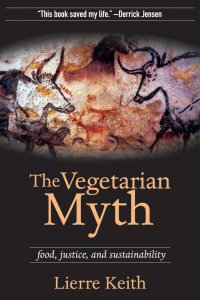 I have one more strong recommendation for vegans and would-be vegans and that is to read “The Vegetarian Myth” by Lierre Keith who was vegan for 20 years, a woman passionate about justice, compassion and equality.
It’s an impassioned, powerful read. Her health was destroyed by 20 years of veganism, a story I’ve heard over and over.
She calls for a “full accounting,” meaning the big picture of what has to die to feed you. Eye-opening, and a good start to explore the bigger picture of diet and how we live. See it on Amazon.com
Best wishes,
Michael Kinnaird
 Happy Guide
“A lot of what you say there is nutritionism, trying to justify in terms of individual nutrients, and while that might seem okay, it’s really not, because making up a diet based on tiny pieces of ideas woven together does not equate to a diet that sustains health over generations.”
You mentioned missing nutrients and that’s why people have problems on the diet. I only pointed out how it is possible to obtain those nutrients on the diet when you said it wasn’t.
“The fact that DHA comes from algae on vegan diets is just evidence it has no basis in nature.”
How so? Algae comes from nature. And who cares as long as you can purchase what you need, in the same supermarket that sells the same packaged refined rancid fish oil and other stuff you didn’t go get yourself. How is taking an algea pill anymore difficult than a fish pill?
“And nutrition is an emerging science… no B12, no DHA, no retinol and poor conversion, what’s next? The diet has too many red flags at the moment to recommend it.”
That problem goes for even people who eat animal sources and still have deficiencies. How do they have deficiencies when they consume sources of it?
Clearly, the USDA is not a vegan biased source…
http://www.ars.usda.gov/is/pr/2000/000802.htm
“Nearly two-fifths of the U.S. population may be flirting with marginal vitamin B12 status if the population of Framingham, Mass., is any indication.”
“Oddly, the researchers found no association between plasma B12 levels and meat, poultry, and fish intake, even though these foods supply the bulk of B12 in the diet. “It’s not because people aren’t eating enough meat,” Tucker said. “The vitamin isn’t getting absorbed.””
lol. So your solution for people to eat more meat for the B12 clearly is already not helping them.
The vegans taking B12 supplements are getting better absorption than those trying to get it from animal sources.
“People in general do not take care, even with more robust diets and their health still fails, so a diet that needs such strict attention to detail is not a diet to recommend generally.””
If their diet is failing on an animal diet, than it doesn’t say much for animal diets. What it says is that no matter what the diet, everyone needs to pay strict attention to detail or it won’t be good.
“The point about cholesterol is that some people don’t make enough, so increasing foods that normally raise cholesterol is not the point. My understanding is that some people need dietary sources of cholesterol. Also, although the body can make cholesterol, it doesn’t mean that’s optimal, just as the body can make glucose from protein, it doesn’t mean it’s optimal… nutritionism again.”
lol. I’m sure that is very rare, and how would they know how much people’s bodies make on their own when 99% of people are getting theirs from dietary sources, and way too much of it. Bad argument for a general “need”, and the argument itself is “nutritionism”, so what is the point. Some people can’t make enough insulin on their own and have to take insulin shots. That proves… what? Proves people are unhealthy…
“Optimal omega-3 and -6 balance is estimated to be 1:1 to 1:4. Since vegan sources of omega-3 tend to come packaged with more omega-6, it makes the balance very hard to achieve. One could eat a ton of flax oil to do it, but you’d prob have to eat so much that it wouldn’t be healthy. Also, we have the conversion issue.”
Certainly worth paying careful attention to, though not impossible. Just avoid vegetable oils and grains. There are plenty of nuts and seeds with good ratios.
“I think I know where you got this from, a well known vegan advocate who says sugar can’t get into cells in the presence of fat. I did a lot of asking around based on that remark, and very many clever science bods wet themselves laughing. Basically, they said “no, not true.” I’m not expert enough about IR to comment, but the general consensus is that it’s an energy overload issue, the cells block reception to insulin because they’re already full of energy, so we end up with too much insulin and too much sugar stuck in the blood, which of course, is terrible news for the body.”
No, I don’t get my information from vegan advocates, I get it directly from scientific sources and studies.
http://www.ncbi.nlm.nih.gov/pubmed/23471217
http://diabetes.diabetesjournals.org/content/54/12/3458.long
“But when Lierre Keith’s hair and teeth are falling out, she is crippled with osteoporosis, she has severe anxiety and anger issues, then eats meat again and begins to heal, it’s a different sort of evidence. And these stories are ten-a-penny.”
Really, I never heard of them. I hear and see plenty of ill health stories of meat eaters with diabetes and osteoporosis and obesity and other ailments thought. And plenty of stories of meat eaters healing their diabetes, weight problems and other ailments after going on a plant based diet. So what evidence is that? If so many meat eaters are not healthy, how is that a good argument to follow that diet?
Perhaps the vegans with bad health didn’t look after themselves good or eat right for the diet, just like the majority of meat eaters don’t eat right. If I used the argument that because so many meat eaters are insanely unhealthy as proof that that diet is unsustainable, same thing.
LikeLike
Hi J,
First of all I will say that I’m in favor of vegan diets in principle, and if people want to try to make it work, who am I to interfere? I just don’t think they work in practice for the reasons in the article.
That’s not to say they CAN’T work, just that they don’t, and until the mechanisms for failure are fully understood, I don’t think recommending them to the general public is a good idea.
A lot of what you say there is nutritionism, trying to justify in terms of individual nutrients, and while that might seem okay, it’s really not, because making up a diet based on tiny pieces of ideas woven together does not equate to a diet that sustains health over generations.
The fact that DHA comes from algae on vegan diets is just evidence it has no basis in nature. And nutrition is an emerging science… no B12, no DHA, no retinol and poor conversion, what’s next? The diet has too many red flags at the moment to recommend it. People in general do not take care, even with more robust diets and their health still fails, so a diet that needs such strict attention to detail is not a diet to recommend generally.
Comparing iron from plant sources to iron from meat is not the same… as with DHA and retinol, many of these nutrients are going to suffer from poor conversion issues because we evolved eating animal foods, our bodies are therefore primed genetically to that diet, a diet in which a lot of the nutrients are already in their usable form. Same with amino acids… the biological value of animal protein is far higher than vegetable protein, you can’t just compare grams to grams in the food.
The point about cholesterol is that some people don’t make enough, so increasing foods that normally raise cholesterol is not the point. My understanding is that some people need dietary sources of cholesterol. Also, although the body can make cholesterol, it doesn’t mean that’s optimal, just as the body can make glucose from protein, it doesn’t mean it’s optimal… nutritionism again.
The DHA for vegans from algae is of course extracted, otherwise, one may encounter problems from unnatural food sources, like B12 analogs competing with useful B12 in the body and causing deficiency.
Optimal omega-3 and -6 balance is estimated to be 1:1 to 1:4. Since vegan sources of omega-3 tend to come packaged with more omega-6, it makes the balance very hard to achieve. One could eat a ton of flax oil to do it, but you’d prob have to eat so much that it wouldn’t be healthy. Also, we have the conversion issue.
“High fat actually causes more insulin resistance. Especially is why it is bad to combine fat and carbs or fat and sugars! The body can deal much easier with the carbs or sugars as long as there are no fatty acids at the same time increasing insulin resistance.”
I think I know where you got this from, a well known vegan advocate who says sugar can’t get into cells in the presence of fat. I did a lot of asking around based on that remark, and very many clever science bods wet themselves laughing. Basically, they said “no, not true.” I’m not expert enough about IR to comment, but the general consensus is that it’s an energy overload issue, the cells block reception to insulin because they’re already full of energy, so we end up with too much insulin and too much sugar stuck in the blood, which of course, is terrible news for the body.
“Though even more grains are grown to feed the animals anyways… that won’t stop. Cheap.”
Well that is not reason to be vegan… better the cows eat grass and we eat the cows, then we have nature operating properly. Education is the right way to get consumers supporting grass-fed animals and there is a big movement towards that at the moment.
“And yet these stories of people’s health being destroyed because of their vegetarian diets are evidence of ‘causation’ from their vegetarian diet? Same problem with that.”
Not really… The China Study is epidemiology… hard to get cause and effect from that. But when Lierre Keith’s hair and teeth are falling out, she is crippled with osteoporosis, she has severe anxiety and anger issues, then eats meat again and begins to heal, it’s a different sort of evidence. And these stories are ten-a-penny. Veganism is promoted on flawed premises, if we only ever listen to a one sided argument it’s not surprising we will come away convinced. Even the vegan dream of no harm to animals is just that… fantasy. Grain harvesting is one example, but there are many. And I wish people would separate cruelty issues from health issues, the two are muddled. Herbivores in nature are killed by predators, and humans killing humanely is a lot better than their final fate would be in nature. I recommend Lierre Keith’s book for a broader view. Even if your views are firm and solid, what harm to see the other side if you feel so secure in your beliefs. But vegans are scared to look, would rather stick with the “truth” they have settled on, whether or not it really is true, or not.
Truth requires an open and honest mind, a willingness to look at all sides, a willingness to be wrong. I always hope to be proved wrong… who wants to stick with wrong ideas?
LikeLike
“Some people need dietary cholesterol and don’t make enough of their own.”
So easy to get cholesterol. The lauric acid in coconut oil increases cholesterol. Fructose REALLY increases cholesterol. Too much.
“Poor conversion in the body of plant-based omega-3 into DHA.”
There are plant based sources of DHA, micro algaes. No need to convert.
“Healthy balance of omega-3 and 6, essential to prevent chronic inflammation is not possible on a vegan diet.”
How so? Not possible is a strong statement. It’s just a balance. There are plenty of sources of plant based omega 3’s. And there are some vegans who don’t touch any grains or legumes.
“Poor conversion of carotenoids to retinoids (vitamin A).”
That only means people have to consume higher amounts of carotenes than they once thought, though doesn’t mean the amount needed is difficult to obtain. Quoted from a doctor:
“This means that vegetarians are going to have to be careful to eat more carotene rich fruits and vegetables (generally, these are the most deeply colored fruits and vegetables) in order to get enough vitamin A. That said, if a person chooses the right fruits and vegetables, it is still quite easy to obtain the RDA for vitamin A. For example, it takes only half a cup of cooked carrots a day to meet the 900 micrograms per day of vitamin A that is recommended for an adult male.”
“B12 is only found in animal foods. Vegan B12 status has been found to be very poor in studies.”
It’s also found in cultured bacteria grown by lab coat farmers and found in the same grocery stores as the animal foods. :)
The majority of people found to be b12 deficient are people that consume animal foods, so it’s obviously not that reliable of a source for them. Even they are better off supplementing.
“Thyroid problems from excess plant goitrogens including soy but also many other plant foods.”
Meat eaters eat plant foods also (I should hope).
“Inadequate zinc, B6 and fat-soluble vitamins A, D, and K2”
Hemp, Pumpkin seeds and other seeds are high in zinc. Hemp seeds contain no phytic acid and only 2oz contain about 50% of the zinc and iron RDA.
B6? Sweet potato, sunflower seeds, spinach.
D? Sunshine
K2? Nato has it. Don’t know much about that vitamin though.
“Lack of high quality, highly absorbable protein.”
Don’t need proteins. We need amino acids. Which are more efficient to get directly from plants and the body put together, than to break down from denatured proteins from animals into the amino acids and then put back together again. The amino acids in plants and seeds are very absorbable.
“Reliance on grains (unnatural for humans) which cause a whole cascade of problems in the long-term.”
Not all vegetarians rely on grains and there is no need to.
“A high carbohydrate diet is a main factor in insulin resistance and inflammation, a primary cause of many diseases, including heart-disease.”
High fat actually causes more insulin resistance. Especially is why it is bad to combine fat and carbs or fat and sugars! The body can deal much easier with the carbs or sugars as long as there are no fatty acids at the same time increasing insulin resistance.
“A grain based diet is a tragedy for nature and the environment.”
Though even more grains are grown to feed the animals anyways… that won’t stop. Cheap.
“Epidemiology is good for creating hypothesis, an idea of possible causation, but cannot show causation itself, further study involving ideally double-blind clinical trials are needed to attempt a first step in teasing out the cause-effect. Attempt is made to isolate a variable while keeping all others constant to test the effect of that single variable.”
And yet these stories of people’s health being destroyed because of their vegetarian diets are evidence of ‘causation’ from their vegetarian diet? Same problem with that.
LikeLike
You’re obsessed with this China Study business. Forget it.Try to move on. I like the ‘experts’ in the film. So funny. I first started laughing when one explained how he went veg because he didn’t like animal abuse, but then decided he would support farmers who are more humane instead. Is there a humane way to raise an animal for killing, and then when in it’s most profitable condition, kill it? Watch it again, but this time imagine a laughing track. It could easily be a comedy sketch. I’m not saying this to be rude or aggressive, it’s just that they have zero credibility…a couple of buffoons. Even I could put a better argument than that for eating meat.
LikeLike
The China Study is the great pillar of vegan dogma, it’s a sham, and so needs to be debunked, as it thoroughly has been.
Dr. Chris Masterjohn is one of the most intelligent, articulate and respectful people involved in cutting edge science of nutrition, you’re very quick to pass judgement on someone you don’t know. He is highly respected, and incredibly knowledgable.
LikeLike
I guess I’m the ‘passionate’ vegan you mentioned. You seem to be the one obsessed with my diet. I’m sorry to hear about the (claimed) poor health of the author, but as my own experience has been the complete opposite, and, although I have also heard many stories about people who have suffered terribly, even dying due to not eating meat, in 50 years I’ve yet to see one person become less healthy through not eating meat. So, what would you have me do? change my diet, even though I’m in top condition? I’m not a theory…I’m actually in my studio now, writing this. I live meat and dairy free, it’s a miracle! Do you work as a butcher by any chance?
LikeLike
You have been vegan for 6, Lierre for 20, the author of The Meat Fix, 26 years before he abandoned veganism. Already covered this.
Dying is definitely less healthy :-)
Yes, of course I would, I think veganism is untenable. I think you are storing up trouble for the future, although you said you were going to be 60 at your next big birthday, so your stores of B12 and other essentials may get you through, I would worry about your lack of DHA for mental health as you age though. How much protein powder are you using? Protein from meat/fish etc comes with a lot of fat soluble vitamins and cofactors you won’t be getting.
LikeLike