
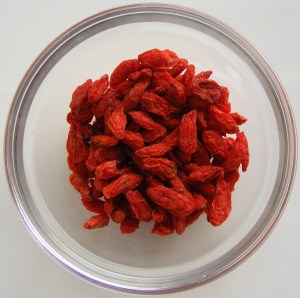
Goji juice and goji berry mania is rife. But is this humble berry the fountain of youth — a “miracle food” as is claimed?
Can it really prevent cancer? Or is it just another case of food fashion meets marketing?
Let’s find out…
Goji facts
Goji Berries, apparently, are “fruit Viagra,” “one pack will have you jumping for joy” and they’re “cellulite-busting,” according to the marketing hype. Hmmm (muses).
Goji berries — pronounced “go-gee” are about the same size as raisins but red and somewhat harder. They’re also known as wolfberries and grow on vines native to the Himalayas. They’re also grown extensively in China, Mongolia, and Tibet…
Renowned in Asia as one of nature’s most nutrient-rich natural foods, the Chinese have been munching on these berries for 2000 years. Traditionally, the goji berry is juiced or used in soups, stir-fry greens or with steamed dishes. Tibetan monks even have a 2 week celebration of the goji every year. No way!
They taste of… well it depends who you ask. Some say a cross between a cranberry and a cherry, or a cranberry and an olive or a raisin and a dried raspberry and some say it tastes like tea… that’s right! Like the tea you drink. I have to agree with the last one too — they taste like tea to me, but then I’ve never had raw or dried cranberries to compare.
Goji berries grow well in the UK and anywhere with a comparable climate. They’ve been naturalized in the UK counties of Norfolk and Suffolk for ages, where they’re used as hedging. In the UK it’s also known as boxthorn, matrimony vine and the Duke of Argyll’s tea tree. It was the Duke who first brought the plant to the UK way back in 1730. I’m only guessing, but maybe they called it “tea tree” because it tastes like tea?
Goji berry nutrition
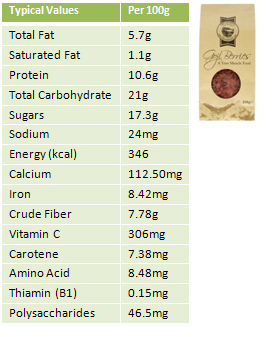 This data is from Tibet Authentic Goji Berries — A True Miracle Food. The nutritional data will vary depending on where the berries come from. Like any food, a lot depends on the soil quality.
I wonder, does anyone really care what nutrients are in food other than to say “yep, this is good for me.” I remember a quote from Doug Graham — ”You should eat bananas because they’ve got banana in them.” :-) Brilliant!
I suppose nutritional data has some value if you know you’re deficient in a certain micronutrient, then you could focus on rebalancing. But overall it’s best to nail your diet to cover all the nutritional bases and leave the rest to your body to sort out.
The “amazing” goji berry has loads of stuff in it that no one will have a clue what they mean but sounds extremely impressive such as betaine, beta sitosterol, cyperone, germanium, lutine, selenium, solavetivone, physalin and zeaxanthin to name but a few.
All these plant factors in goji berries are associated with positive health benefits. Cool. But it’s the polysaccharides that are causing the big stir. More about that later…
The berries are claimed by many to have more vitamin C than oranges, more beta-carotene than carrots and more iron than steak, weight for weight. It’s a bit of an unfair comparison though because these are dried berries, so all the water weight is removed.
You’d have to compare them to dried oranges and dried carrots, no? Another reasonable comparison would be to look at the amount of vitamin C say, per calorie. That would give meaningful results because the number of calories is the limiting factor in any diet. So I did just that… I entered 350 calories of oranges on fitday.com and here’s the comparable data for oranges (the figures in brackets are the percentages of the RDA or Recommended Daily Amount)…
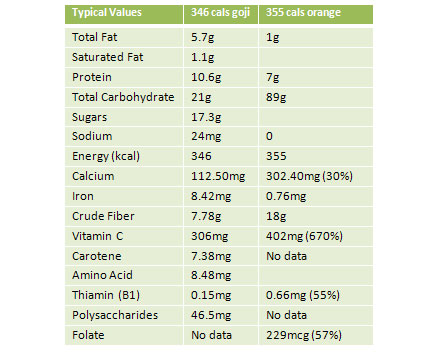
So you can easily see that on a calorie basis the oranges kick goji butt for vitamin C. Oranges also win easily in the calcium and thiamin stakes! So, at least as far as the vitamin C claim goes, it’s a case of half truths combined with the old “lies, damn lies and statistics.”
As for its very high iron content, I can’t help wondering if this is an error that’s crept in somewhere along the line. I’ve compared goji berries to other berries which all seem to be coming out at about 0.75 to 1.0mg per 350 calories of berries. If you know of a reliable source for the iron content of goji berries, let me know. They’re not listed on the USDA database.
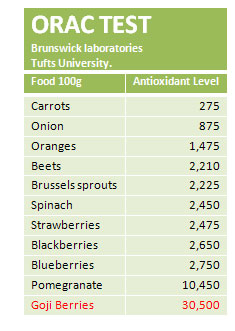 Based on the USDA’s ORAC test, the goji berry has high antioxidant levels. But again the same error has crept in. Testing the amount of antioxidants per 100g of food is just not a fair test if some is dried and some fresh. It’s pretty meaningless for comparison purposes.
Checking out a document about the USDA’s ORAC test I see that prunes and raisins top the fruit chart — dried fruit! Does this mean dried fruit is best? Absolutely not. Think nutrients per calorie not per gram.
Fashion
Madonna, Kate Moss, Liz Hurley and Mischa Barton are all reported to be lovin’ the goji.
And the go-go goji has already made the giant leap from the hippy hangout health store into the supermarket with both Tesco’s and Sainsbury’s in the UK stocking them now.
Cost
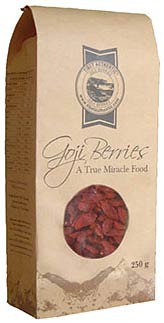 A 250g bag of Goji Berries (image left) costs $14.95 from organichealthandbeauty.com (retail price is $17.99).
UK goji fans can expect to pay around £9.00 for 250g at the supermarket. You can buy them for around £6.00 on-line although like all foods, quality will vary.
I’ve seen reports that not all organic goji berries are really organic so watch out for that. I reckon the price will come down as farmers in the West catch on to the commercial value of goji.
Goji scam?
In January 2007, Earl Mindell was lambasted by CBC Marketplace in a fascinating interview and exposé for allegedy taking advantage of sick folks to make huge profits selling goji juice. His business empire is massive. His goji meetings are like religious events with Mindell as “master.”
His product — Freelife “Himalayan” Goji Juice is actually made from berries not grown in the Himalayas! His reasoning is that the “unique” polysaccharide profile is the same as the Himalayan sort. Hmmm I don’t like that kind of thing. Either it’s Himalayan or it ain’t.
Mindell claims that only his juice has the exact profile of these “master” molecules — “There simply is no other product on the market like it.” He also claims he’s going to close half the hospitals!
To use Freelife (a pyramid marketed product with top sellers making $170,000-$1,700,000 a year according to freelife), expect to shell out $50 per bottle or about $250 for a months supply. I feel sad. This smacks of exploiting sick people. Can folks not get the benefit of goji berries that doesn’t involve a $250 per month cost?
The Marketplace program said that many of his claims are false. In lab tests, his juice contained virtually no B or E vitamins and no beta carotene. The lab tests also found his “unique” product to be similar to other juices.
Mindell responded by citing 76 peer reviewed studies that support his health claims. He’s written a book on Goji that lists 34 health benefits — even that it prevents cancer.
Dr. Steven Zegar, who researches natural health products for cancer treatment at McMaster University has reviewed many of the goji studies. He says Mindell has extrapolated bits of these studies and is using them out of context. The polysaccharides could have health benefits but there’s little proof to back up the hype.
Dr Bradlow of Hackensack University in New Jersey said…
“It inhibited the growth of cells in a dish… a little dish like this isn’t the same as a person.
There’s absolutely no proof it would have that effect on a human… there’s no justification for encouraging people to take this as an anti-cancer drug… it’s misrepresentation of the facts… it’s unbelievable how many unscrupulous souls there are out there, trying to pedal an unproven product… there’s lots of single studies that turned out to be one shot wonders.”
In Mindell’s defense, I reckon goji berries do have cancer preventing qualities. Plant food in general have been shown in many studies to have anti-cancer properties and antioxidants are known to “mop up” free radicals which can cause DNA damage. Since goji is a highly nutritious berry, it’s fair to say that it has anti-cancer properties.
Unfortunately for Mindell, you just can’t say it without proof. Also, his juice is lacking many of the health benefits of the berry itself. Surely if he really wanted the best for people, he would be recommending the berries and not his extremely expensive juice?
Also in Mindell’s defense, it’s mainly the polysaccharides that he’s promoting in his juice. But again I have to ask why not just eat the berry and get the other benefits as well at a much reduced cost?
In the Marketplace interview, he urges folks to go to pubmed.gov and do a search for “Lycium Barbarum” (the latin name for goji berries). Well I did just that — 83 results of studies relating to goji or its extracts (to put this into perspective, I did a search on pubmed for broccoli that came up with 5416 studies). So, a few more have been added since the Marketplace interview. Having a quick flick through, three things sprung to mind.
Firstly, not many people will have a clue how to interpret these studies. To pick one purely at random…
“Effect of lycium barbarum polysaccharide on human hepatoma QGY7703 cells: inhibition of proliferation and induction of apoptosis.”
Brain freeze!
I’m sure you’re dying to know what the outcome of that particular study was eh? Well…
“The study suggests that the induction of cell cycle arrest and the increase of intracellular calcium in apoptotic system may participate in the antiproliferative activity of LBP in QGY7703 cells.”
Phew, I’m glad we cleared that up!
Secondly, a lot of these studies are just not relevant to the claims made by Mindell… stuff like “How to extract the polysaccharides” and so-on.
Thirdly, most of these studies were done in China. Call me a cynic but the Chinese would have a lot to gain from goji acquiring a reputation for healing cancer and other illnesses.
Having said that, looking at this from a layman’s perspective, there are some extremely interesting studies about goji polysaccharides on pubmed.org and many concluding remarks from these studies do suggest they have anti-cancer properties, especially at the right dose. Check out the Sloane-Kettering goji article for a good summary of the relevant research so far.
UK ban
The Food Standards Agency (FSA) may impose a ban on goji berries unless it can be shown that they’ve been consumed in significant amounts within the EU before May 1997. If it can’t be shown, then goji berries would be classed as a “novel food” within EU law and it could take two years to get approval to sell them.
The cut off point for new information was 23 March 2007 but I’ve not heard of a decision being made as yet. It’s hard to take this seriously — it’s a berry!!
The FSA do seem to be sharing this view, they’ve said on their site;
“There are no immediate safety concerns over goji berries and local authorities will take this into account when deciding on appropriate enforcement action.”
I can’t see a ban happening, and even if it does, you can always…
Grow your own gojis
They’re readily available nowadays from nurseries. I just ordered some from Thompson and Morgan for only £14 for 3 plants. My garden is full of all sorts of berries because as well as being nutritional powerhouses, they’re expensive to buy.
Don’t waste your time and energy growing stuff that’s cheap to buy — why bother, unless it’s just for fun. Grow the expensive stuff I say :-) If you’re going to try to sun dry your berries, don’t touch them or they’ll oxidize and go black. Shake onto a mat instead of picking by hand.
Health warnings!
As is the case for cranberries, folks taking Warfarin should not use goji products without consulting their doctor.
Got Goji? Got Cavities! Well, all and any dried fruits are going to be a nightmare for teeth. Sweet and sticky is not a good combination. The fruit sticks to teeth and the plaque will do the rest. I wouldn’t recommend eating them dried unless you can brush you teeth afterwards. If you soak them for about 30 mins or even overnight, this will probably avoid the cavity problem.
The goji berry is part of the “nightshade” family of plants which also include potatoes, tomatoes, and eggplant. If you’re allergic to any of the nightshades, which is quite common, you may have problems with goji berries.
Oh, and don’t be tempted to make tea out of the “tea tree” leaves… they’re toxic.
Food or medicine?
Hippocrates, the father of medicine said “Let food be thy medicine and medicine be thy food.” How bizarre then, that doctors still swear the Hippocratic Oath but fail so badly to take Hippocrates advice on using food as medicine.
For me, Goji is just great nutritious food. If you have an illness it might be worth thinking about upping your daily dose. 10 to 30g is recommended as a daily serving.
If I had cancer, I would be wanting to give myself every chance of a cure and even if it’s not yet officially proven, the goji polysaccharides show promise — I wouldn’t be waiting for science and would be looking at lot more deeply at goji as well as other well known natural foods with known anti-cancer activity.
In general, the “pill for an ill” mindset is very deeply ingrained, even when the “pill” is a food. There is no silver bullet, no one food is the answer to health. Health is created by living a healthy lifestyle and nutritious food is a big part of that… My concern is that folks looking for the silver bullet are going to miss the big picture.
Summing up
Never, ever, ever take information on a sales page or from the seller as accurate. All sorts of wild claims are made for goji and sales pages are just not a good place to look for solid information. From my research into this article, I feel goji berries are a great food and a very nutritious food.
If you can afford them, I see no reason not to add them to your diet occasionally. Are they better than other berries? I’m not sure about that. The fact that they come from largely unspoilt locations grown in rich soils could account for their high nutritional content.
You have to wonder — if this really is the fountain of youth, why the Chinese aren’t all living to 200 years old or even topping the list of longest-lived nations. Or for that matter, why Earl Mindell isn’t beaming with health and vitality. Perhaps the stress of running his multi-million dollar industry is taking its toll :-)
In a response to the Marketplace exposé of Mindell, Freelife issued an official statement and offered up a Memorial Sloane-Kettering Cancer Center webpage on goji berries which is quite strange since Sloane-Kettering state that the data on goji is inconclusive and that much more large scale human research is needed.
You can look at nutrition from a million different angles and come up with the same answer — eat more fruits and veg. The next BIG thing… broccoli, watch this space!
If you feel that anything in this article is incorrect, have another point of view or just want to say ‘hi’, please leave a comment below.
Free chapter

Michael Kinnaird is the author of Happy Guide, the result of a 20 year exploration into what works for health and happiness.
Read Chapter 1 “The Happiness Secret”
Or get the paperback…
Keep in touch
Get inspiration in your inbox from Happy Guide…
 Happy Guide
Hi Mel,
Life’s not fair is it? Like it’s not fair that you live near a beach and I don’t!! :-) Grrrr!
I honestly don’t think that goji juice is the answer for you and yes, you’re right — genetics is a massive factor. Incidently, just because folks seem healthy and have no symptoms doesn’t mean their lifestyle isn’t hurting them.
In your position I would switch to natural human food overnight. No grains, no dairy. I would try that for a few months and if I was a betting man, I would put money on all these colds going away quite quickly.
Fruits, veg, nuts, seeds, meat, fish, eggs etc.
Plan your meals and enter a day’s food into an online diet analysis tool such as fitday.com to make sure you’re covering all the main nutritional bases.
You’ll need to up your greens considerably in order to get enough calcium in your diet and also get a little sun every day without all the sunblock! 15 to 30 minutes is fine. You need the natural vitamin D.
Eat more potatoes, yams and squashes as calorie staples instead of bread and eat more fruit too.
If you decide to try this, come back and let me know how you get on or if you have any questions at all.
It’s also a remote possibility that the “nightshade” family is bothering you. Prob not but if the colds persist you might need that extra step. That means also eliminating potatoes, tomatoes, peppers and egg plant/aubergines.
Mike.
LikeLike
Hi Mike,
Thanks for your reply. I guess my reason for looking up information on the Gogi berry or Ningxa Red was sheer frustration (I am at a loss!). I seem to always get sick (mainly colds), if someone has a cold and I go near them….I get it!! What I can’t understand is why??? I am 33 and have a very slim build and have never had a weight problem. I love healthy food and never eat junk food (no soft drink, lollies or fast food). I think I have a fairly healthy diet – muesli and bran for breakfast often with blueberries or mango. Lunch is usually a sandwich on brown bread and dinner is usually meat and vegies. I also take a multi vitamin (Usana) and I exercise several times a week. (surfing, swimming and windsurfing). I live in Australia near the beach and am a mum of 2 (so no job stress..but I guess being a mum is a little stressful!!..I have a 6 month old and a 2 year old). But your right…I don’t particularly want to spend a fortune on fancy over priced juices….especially if they are not going to make a huge difference. I read that you grow your own gogi berries…although I have not heard of anyone growing them around my area (I don’t think the climate is right). I know my chemist sells dried gogi berries (but again …not cheap). But I am wondering if they will make a difference or perhaps I was just born with a bad immune system?? Perhaps it is a genetic thing? My husband hardly ever gets sick and eats whatever he wants, drinks alcohol every weekend and has NEVER taken any vitamins in his life..yet always seems to be healthier than me!!
I dont have any other major health problems…but would love to be cold free for at least 6 months or more!!
LikeLike
Hi,
Just wondering if the Goji Berry and Ningxa Red are the same thing? or completely different? I am also interested to find anyone who takes NIngxa Red and DOESNT SELL it. A met a lady the other day who was telling me how wonderful Ningxa Red is and even gave me a sample to try. I didnt realise till I got on the website that if I was to buy the product she gets a commission! She claims that she wouldnt sell it unless she thought it was great…she claims that she has tried many products over many, many years and this has been the best (she used to take Usana Vitamins as I do) and claims this product (Ningxa Red) is way better. I was also curious if there has been any research done on Ningxa Red other than in China?
I Understand that I probably should be getting all my nutrients etc from a healthy, balanced diet but I question the amount of goodness that is still in the fruit and Veg that we buy today. By the time it goes from the growers to the stores…and then sits in my Vegie crisper for a few days…is there any goodness left??
LikeLike
Hi Mel,
Well goji or wolfberry is grown in a lot of places. As far as I’m aware, the Ningxia one is grown in a particularly rich soil due to rivier flooding which deposits mineral rich silt.
As you probably guessed if you read the article, I’m not in favor of supplements over a healthy diet. Yes goji will have benefit for most people — it’s very nutritious and alkalizing but is it value for money? I think not.
If you want goji why not eat the berries for a fraction of the price? And you get to keep the valuable fibre content.
Berries in general, not just goji are great foods. Nutrient dense and high anti-oxidant levels. I eat 2 portions (160g) every single day.
I agree there are nutrient losses when fruit and veg is shipped but that’s not why people are getting sick. The reason for sickness is poor diet, too much stress combined with many other lifestyle and environmental factors. Nutrient losses are just one small aspect.
I watch what people eat. In general people are living on rubbish — high fat poor quality diets. That’s one of the big factors.
And there are things you can do about nutrient losses. Eat some frozen stuff, buy local organic from farmers’ markets. Shop more often etc.
But in my experience — eating MORE — 10+ per day is the biggie. More if you’re sick.
Cheers
Mike.
LikeLike
This is the best unbiased account regarding goji berries that I’ve read. The comparison between goji and oranges with regards to vitamin c is truly enlightening. Thanks.
LikeLike