
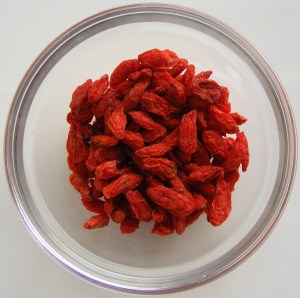
Goji juice and goji berry mania is rife. But is this humble berry the fountain of youth — a “miracle food” as is claimed?
Can it really prevent cancer? Or is it just another case of food fashion meets marketing?
Let’s find out…
Goji facts
Goji Berries, apparently, are “fruit Viagra,” “one pack will have you jumping for joy” and they’re “cellulite-busting,” according to the marketing hype. Hmmm (muses).
Goji berries — pronounced “go-gee” are about the same size as raisins but red and somewhat harder. They’re also known as wolfberries and grow on vines native to the Himalayas. They’re also grown extensively in China, Mongolia, and Tibet…
Renowned in Asia as one of nature’s most nutrient-rich natural foods, the Chinese have been munching on these berries for 2000 years. Traditionally, the goji berry is juiced or used in soups, stir-fry greens or with steamed dishes. Tibetan monks even have a 2 week celebration of the goji every year. No way!
They taste of… well it depends who you ask. Some say a cross between a cranberry and a cherry, or a cranberry and an olive or a raisin and a dried raspberry and some say it tastes like tea… that’s right! Like the tea you drink. I have to agree with the last one too — they taste like tea to me, but then I’ve never had raw or dried cranberries to compare.
Goji berries grow well in the UK and anywhere with a comparable climate. They’ve been naturalized in the UK counties of Norfolk and Suffolk for ages, where they’re used as hedging. In the UK it’s also known as boxthorn, matrimony vine and the Duke of Argyll’s tea tree. It was the Duke who first brought the plant to the UK way back in 1730. I’m only guessing, but maybe they called it “tea tree” because it tastes like tea?
Goji berry nutrition
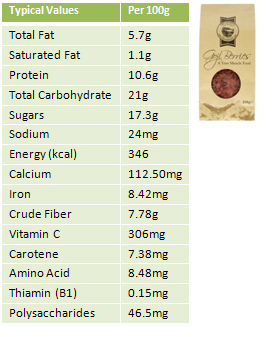 This data is from Tibet Authentic Goji Berries — A True Miracle Food. The nutritional data will vary depending on where the berries come from. Like any food, a lot depends on the soil quality.
I wonder, does anyone really care what nutrients are in food other than to say “yep, this is good for me.” I remember a quote from Doug Graham — ”You should eat bananas because they’ve got banana in them.” :-) Brilliant!
I suppose nutritional data has some value if you know you’re deficient in a certain micronutrient, then you could focus on rebalancing. But overall it’s best to nail your diet to cover all the nutritional bases and leave the rest to your body to sort out.
The “amazing” goji berry has loads of stuff in it that no one will have a clue what they mean but sounds extremely impressive such as betaine, beta sitosterol, cyperone, germanium, lutine, selenium, solavetivone, physalin and zeaxanthin to name but a few.
All these plant factors in goji berries are associated with positive health benefits. Cool. But it’s the polysaccharides that are causing the big stir. More about that later…
The berries are claimed by many to have more vitamin C than oranges, more beta-carotene than carrots and more iron than steak, weight for weight. It’s a bit of an unfair comparison though because these are dried berries, so all the water weight is removed.
You’d have to compare them to dried oranges and dried carrots, no? Another reasonable comparison would be to look at the amount of vitamin C say, per calorie. That would give meaningful results because the number of calories is the limiting factor in any diet. So I did just that… I entered 350 calories of oranges on fitday.com and here’s the comparable data for oranges (the figures in brackets are the percentages of the RDA or Recommended Daily Amount)…
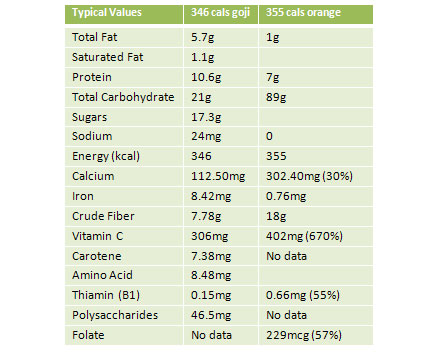
So you can easily see that on a calorie basis the oranges kick goji butt for vitamin C. Oranges also win easily in the calcium and thiamin stakes! So, at least as far as the vitamin C claim goes, it’s a case of half truths combined with the old “lies, damn lies and statistics.”
As for its very high iron content, I can’t help wondering if this is an error that’s crept in somewhere along the line. I’ve compared goji berries to other berries which all seem to be coming out at about 0.75 to 1.0mg per 350 calories of berries. If you know of a reliable source for the iron content of goji berries, let me know. They’re not listed on the USDA database.
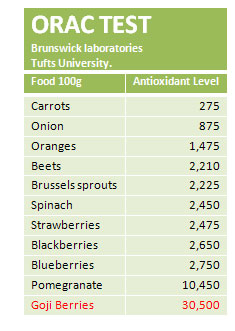 Based on the USDA’s ORAC test, the goji berry has high antioxidant levels. But again the same error has crept in. Testing the amount of antioxidants per 100g of food is just not a fair test if some is dried and some fresh. It’s pretty meaningless for comparison purposes.
Checking out a document about the USDA’s ORAC test I see that prunes and raisins top the fruit chart — dried fruit! Does this mean dried fruit is best? Absolutely not. Think nutrients per calorie not per gram.
Fashion
Madonna, Kate Moss, Liz Hurley and Mischa Barton are all reported to be lovin’ the goji.
And the go-go goji has already made the giant leap from the hippy hangout health store into the supermarket with both Tesco’s and Sainsbury’s in the UK stocking them now.
Cost
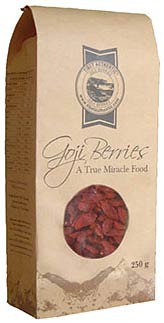 A 250g bag of Goji Berries (image left) costs $14.95 from organichealthandbeauty.com (retail price is $17.99).
UK goji fans can expect to pay around £9.00 for 250g at the supermarket. You can buy them for around £6.00 on-line although like all foods, quality will vary.
I’ve seen reports that not all organic goji berries are really organic so watch out for that. I reckon the price will come down as farmers in the West catch on to the commercial value of goji.
Goji scam?
In January 2007, Earl Mindell was lambasted by CBC Marketplace in a fascinating interview and exposé for allegedy taking advantage of sick folks to make huge profits selling goji juice. His business empire is massive. His goji meetings are like religious events with Mindell as “master.”
His product — Freelife “Himalayan” Goji Juice is actually made from berries not grown in the Himalayas! His reasoning is that the “unique” polysaccharide profile is the same as the Himalayan sort. Hmmm I don’t like that kind of thing. Either it’s Himalayan or it ain’t.
Mindell claims that only his juice has the exact profile of these “master” molecules — “There simply is no other product on the market like it.” He also claims he’s going to close half the hospitals!
To use Freelife (a pyramid marketed product with top sellers making $170,000-$1,700,000 a year according to freelife), expect to shell out $50 per bottle or about $250 for a months supply. I feel sad. This smacks of exploiting sick people. Can folks not get the benefit of goji berries that doesn’t involve a $250 per month cost?
The Marketplace program said that many of his claims are false. In lab tests, his juice contained virtually no B or E vitamins and no beta carotene. The lab tests also found his “unique” product to be similar to other juices.
Mindell responded by citing 76 peer reviewed studies that support his health claims. He’s written a book on Goji that lists 34 health benefits — even that it prevents cancer.
Dr. Steven Zegar, who researches natural health products for cancer treatment at McMaster University has reviewed many of the goji studies. He says Mindell has extrapolated bits of these studies and is using them out of context. The polysaccharides could have health benefits but there’s little proof to back up the hype.
Dr Bradlow of Hackensack University in New Jersey said…
“It inhibited the growth of cells in a dish… a little dish like this isn’t the same as a person.
There’s absolutely no proof it would have that effect on a human… there’s no justification for encouraging people to take this as an anti-cancer drug… it’s misrepresentation of the facts… it’s unbelievable how many unscrupulous souls there are out there, trying to pedal an unproven product… there’s lots of single studies that turned out to be one shot wonders.”
In Mindell’s defense, I reckon goji berries do have cancer preventing qualities. Plant food in general have been shown in many studies to have anti-cancer properties and antioxidants are known to “mop up” free radicals which can cause DNA damage. Since goji is a highly nutritious berry, it’s fair to say that it has anti-cancer properties.
Unfortunately for Mindell, you just can’t say it without proof. Also, his juice is lacking many of the health benefits of the berry itself. Surely if he really wanted the best for people, he would be recommending the berries and not his extremely expensive juice?
Also in Mindell’s defense, it’s mainly the polysaccharides that he’s promoting in his juice. But again I have to ask why not just eat the berry and get the other benefits as well at a much reduced cost?
In the Marketplace interview, he urges folks to go to pubmed.gov and do a search for “Lycium Barbarum” (the latin name for goji berries). Well I did just that — 83 results of studies relating to goji or its extracts (to put this into perspective, I did a search on pubmed for broccoli that came up with 5416 studies). So, a few more have been added since the Marketplace interview. Having a quick flick through, three things sprung to mind.
Firstly, not many people will have a clue how to interpret these studies. To pick one purely at random…
“Effect of lycium barbarum polysaccharide on human hepatoma QGY7703 cells: inhibition of proliferation and induction of apoptosis.”
Brain freeze!
I’m sure you’re dying to know what the outcome of that particular study was eh? Well…
“The study suggests that the induction of cell cycle arrest and the increase of intracellular calcium in apoptotic system may participate in the antiproliferative activity of LBP in QGY7703 cells.”
Phew, I’m glad we cleared that up!
Secondly, a lot of these studies are just not relevant to the claims made by Mindell… stuff like “How to extract the polysaccharides” and so-on.
Thirdly, most of these studies were done in China. Call me a cynic but the Chinese would have a lot to gain from goji acquiring a reputation for healing cancer and other illnesses.
Having said that, looking at this from a layman’s perspective, there are some extremely interesting studies about goji polysaccharides on pubmed.org and many concluding remarks from these studies do suggest they have anti-cancer properties, especially at the right dose. Check out the Sloane-Kettering goji article for a good summary of the relevant research so far.
UK ban
The Food Standards Agency (FSA) may impose a ban on goji berries unless it can be shown that they’ve been consumed in significant amounts within the EU before May 1997. If it can’t be shown, then goji berries would be classed as a “novel food” within EU law and it could take two years to get approval to sell them.
The cut off point for new information was 23 March 2007 but I’ve not heard of a decision being made as yet. It’s hard to take this seriously — it’s a berry!!
The FSA do seem to be sharing this view, they’ve said on their site;
“There are no immediate safety concerns over goji berries and local authorities will take this into account when deciding on appropriate enforcement action.”
I can’t see a ban happening, and even if it does, you can always…
Grow your own gojis
They’re readily available nowadays from nurseries. I just ordered some from Thompson and Morgan for only £14 for 3 plants. My garden is full of all sorts of berries because as well as being nutritional powerhouses, they’re expensive to buy.
Don’t waste your time and energy growing stuff that’s cheap to buy — why bother, unless it’s just for fun. Grow the expensive stuff I say :-) If you’re going to try to sun dry your berries, don’t touch them or they’ll oxidize and go black. Shake onto a mat instead of picking by hand.
Health warnings!
As is the case for cranberries, folks taking Warfarin should not use goji products without consulting their doctor.
Got Goji? Got Cavities! Well, all and any dried fruits are going to be a nightmare for teeth. Sweet and sticky is not a good combination. The fruit sticks to teeth and the plaque will do the rest. I wouldn’t recommend eating them dried unless you can brush you teeth afterwards. If you soak them for about 30 mins or even overnight, this will probably avoid the cavity problem.
The goji berry is part of the “nightshade” family of plants which also include potatoes, tomatoes, and eggplant. If you’re allergic to any of the nightshades, which is quite common, you may have problems with goji berries.
Oh, and don’t be tempted to make tea out of the “tea tree” leaves… they’re toxic.
Food or medicine?
Hippocrates, the father of medicine said “Let food be thy medicine and medicine be thy food.” How bizarre then, that doctors still swear the Hippocratic Oath but fail so badly to take Hippocrates advice on using food as medicine.
For me, Goji is just great nutritious food. If you have an illness it might be worth thinking about upping your daily dose. 10 to 30g is recommended as a daily serving.
If I had cancer, I would be wanting to give myself every chance of a cure and even if it’s not yet officially proven, the goji polysaccharides show promise — I wouldn’t be waiting for science and would be looking at lot more deeply at goji as well as other well known natural foods with known anti-cancer activity.
In general, the “pill for an ill” mindset is very deeply ingrained, even when the “pill” is a food. There is no silver bullet, no one food is the answer to health. Health is created by living a healthy lifestyle and nutritious food is a big part of that… My concern is that folks looking for the silver bullet are going to miss the big picture.
Summing up
Never, ever, ever take information on a sales page or from the seller as accurate. All sorts of wild claims are made for goji and sales pages are just not a good place to look for solid information. From my research into this article, I feel goji berries are a great food and a very nutritious food.
If you can afford them, I see no reason not to add them to your diet occasionally. Are they better than other berries? I’m not sure about that. The fact that they come from largely unspoilt locations grown in rich soils could account for their high nutritional content.
You have to wonder — if this really is the fountain of youth, why the Chinese aren’t all living to 200 years old or even topping the list of longest-lived nations. Or for that matter, why Earl Mindell isn’t beaming with health and vitality. Perhaps the stress of running his multi-million dollar industry is taking its toll :-)
In a response to the Marketplace exposé of Mindell, Freelife issued an official statement and offered up a Memorial Sloane-Kettering Cancer Center webpage on goji berries which is quite strange since Sloane-Kettering state that the data on goji is inconclusive and that much more large scale human research is needed.
You can look at nutrition from a million different angles and come up with the same answer — eat more fruits and veg. The next BIG thing… broccoli, watch this space!
If you feel that anything in this article is incorrect, have another point of view or just want to say ‘hi’, please leave a comment below.
Free chapter

Michael Kinnaird is the author of Happy Guide, the result of a 20 year exploration into what works for health and happiness.
Read Chapter 1 “The Happiness Secret”
Or get the paperback…
Keep in touch
Get inspiration in your inbox from Happy Guide…
 Happy Guide
Mike,
Just curious, how has the growing of the goji plants gone? Yield?
Thank you for your article – I am researching the goji and appreciate seeing all sides.
BTW, I live in the Portland, OR metro area-any ideas on local Chinese markets I can get the berries from?
LikeLike
I’ve just been reading Mike Kinnaird’s brilliant article The Great Goji Juice Controversy, where he discusses Goji facts, nutrition, the Goji scam, and much more. It’s a really great article, and if your interested in this, you should go over and check out his post.
LikeLike
Hi Becky, thanks for your heart warming story. I guess if I were in as bad a state as you and someone offered me hope in the form of goji juice for $32 I would take it–sure.
I was sick too. For 13 years with Chronic Fatigue Syndrome, the symptoms are quite similar to fibromyalgia. I understand what you’ve been through believe me.
What I really take from your story is how let down we all are by the prevailing scientific and social state of affairs. Stories of healings like yours and mine are 10 a penny and yet who in the science and medical world is standing up and saying “Hey, look at this, this is amazing–we NEED TO LOOK AT THIS and NOW.” If this thing really works and Mindell can prove it, why aren’t the medical profession beating down his door to access this information so that it can all be done professionally? In fact, why isn’t Mindell beating THEIR door down?
It’s quite scandalous that you, as a patient, should have to figure it all out for yourself and go by trial and error to marketeers for medical information and ultimately, healing. This should have been resolved a long time ago but the doctors and drugs can’t help you. Why? Because chronic illnesses of every type do not and cannot respond to drugs and surgery — their big guns.
Dave Klein who focuses on ulcerative colitis and Crohn’s and gets a 99% success rate with his method says “The medics DON’T WANT TO KNOW.”
Isn’t that incredibly frustrating and annoying?
The benefits and amazing healing power of fasting has been known about for centuries but are the medics interested? Are they even looking?
What about all the natural and freely available herbal and wild plant cure that is contained in the combined wisdom on hundreds of indigenous peoples who, over thousands of years have gained and passed on intricate knowledge of healing plants and their uses.
Who is looking? NOBODY. “THEY DON’T WANT TO KNOW.” Sadly, the golden rule is “He who has the gold makes the rules.”
I wonder how much the obvious conflict of interest blinds the medical profession as a whole: If they tell us how to create health they effectively put themselves out of a job.
Why is it that in the year 2007, we are still arguing about what is best to eat for health? Is this the DARK AGES???
What has the combined might of nutritional science given us? A million books, articles and papers on every different possible idea and angle about what is the best diet by individuals and organizations wilh an interest.
It’s outrageous.
Even our governments are corrupted by powerful lobbying by the drug and food industries… and all the while you… and me… and thousands like us have suffered a tremendous amount without need to if only we’d all unite behind a common cause and purpose of health CREATION.
I’m glad the juice worked for you. I have my serious doubts that berries wouldn’t have worked at less expense but I agree that if it worked for you then who cares.
My problem is more with the marketing of freelife. This is about profit, make no mistake and that makes me sad. Not that they shouldn’t make money. Of course, everyone is entitled to make money but what makes me sad is exploitation.
I’m happy for you. I hope you continue to improve and look for more ways to create lasting health for yourself and loves ones.
Thanks again for your moving story.
Mike
LikeLike
I have been drinking GOJI JUICE for about 18 months. My physical body and health have greatly improved. I have a series of blood tests, X-Rays, and MRIs to support how much MY body has changed while drinking GOJI JUICE. Nothing else helped me, and I didnt change anything I was doing, except start drinking the GOJI JUICE.
I was almost totally crippled due to fibromyalgia, lymphedema, spinal disc problems, to name a few of my health challenges. I could not stand up straight anymore, I could not go up steps anymore, I could not walk more than few steps without needing to sit down or lean on something. My life was so limited, and I was despondent, hopeless, and deeply depressed.
Within weeks after starting to drink it, my pain lessened, my energy increased, I could sleep more than an hour or so at a time. Now, I sleep for 7-8 hours, I can run up steps, I am losing weight, I am not depressed, I have little pain or restriction, I am walking in a pool for 3-4 hours to strengthen my muscles which were severely weakened by the fibromyalgia.
I used to take maximum doses of a pain pill, a muscle relaxer, and an anti-inflammatory drug. I took them for at least 7 years, and they caused side effects and just kept barely able to get in and out of bed.
After drinking the GOJI Juice for one month, I decided to take a leap of faith. I stopped taking ALL drugs and have not taken one drug in about 17 months. I had a car accident in April of this year, and still did not take one drug to get better. I just drank more GOJI Juice!
Blood tests show significant changes, the X-Rays and MRIs show NO disc herniations, and little cervical degeneration even though I started showing rapid degeneration when I was in my early 30s.
Some of the info that has been written HERE about GOJI Juice and FReelife is WRONG. A bottle of GOJI juice from FreeLife does NOT cost $50. It can be purchased for as little as $32. You drink 1 oz a day, so that bottle lasts ONE MONTH!
I wonder how many people who have written here take a drug that costs more than $32 a month, or needs to see their doctor and pays more than $32 a month.
Would YOU pay $32 a month to be able to walk again, to sleep through the night again, to be able to work again, to be able to live a more full life, to NOT spend time thinking of ways to die because the pain is unbearable on a DAILY basis, to have hope in your future again…???.. TELl me… would YOU pay $32 a month for that kind of freedom and peace and health…???..
Most of the info was about GOJI berries, not the juice. The reason that juice is better is because for people who are ill, whose bodies no longer function anywhere near normal, the juice is more easily absorbed and metabolized. IF one’s body is too ill, and they are malnourished because their body can no longer properly digest and utilize the food, then the berries would be eliminated without being absorbed.
IF you are perfectly healthy, then dont bother with GOJI JUICE. None of this matters to you. Why worry about berries VS juice LOL
BUT, if you have an illness, if your life is more and more limited, if your options have all been exercised with no real improvement, if the druges are causing too many side effects… then maybe its worth $32 for you to try some GOJI Juice.
FreeLife has a 100% money back guarantee if you dont feel any better after drinking the bottle. Yes, it is an empty bottle, 90 day, 100% money back guarantee. I liked that in the beginning, because I was also skeptical. I had given up and didnt think ANYTHING could help me.
Does your pharmacy offer YOU a money back guarantee if the drugs it sells you dont help? Does your doctor offer you your money back if he/she doesnt cure you?
It doesnt matter to ME what the skeptics say. My life has been saved and changed by drinking GOJI JUICE every single day. I HAVE a life now. I am no longer a disabled, house bound, depressed, hopeless woman just waiting to DIE…!!!..
LikeLike
Interesting webpage, very informative. I was in a health food store today, looking at Goji berries. There was a brand there called Navitas Goji berries. They were extremely expensive, about $35.00 for a pound!!
I looked at the back of the bag, and they had the berry nutrition information listed. The numbers were way too high. I compared them to another brand, and it appears that Navitas has inflated the nutrition information!
They also called their Goji berries “Lycium eleganus”. It turns out there is no such thing! They just made up the name, so they could rebrand their Goji berries, and change the nutrition panel, and charge more for them!
There is also an article out there, about how a journalist went to Tibet and tried to find the so-called Tibetan Goji berry, and it does not exist as a product!! Its a fraud.
Its one thing that salespeople are selling over-hyped berries to health food customers. But when they appear to be falsifying nutrition labels, and marketing unproven and false claims to people who are sick with cancer, then its time to notify the FTC and FDA.
Navitas does not call their berries that bogus name on their website, or post the alleged faked nutrition information.
They even say on their website that they use Goji berries from China, and don’t call them “Lycium eleganus” there, but they do call them that fake name on Amazon.com
They also say on Amazon that it gives 45% of the RDA for Vitamin A, but on the package it said 180% for the same size serving, and all the other numbers were falsely inflated as well.
“45% RDA of Vitamin A per serving; three grams of fiber per serving; a good source of Vitamins C”
But they DO claim the falsified and inflated numbers for these same Goji berries, on the same website!!
“180% RDA of Vitamin A and 30% RDA of Vitamin C per serving”.
That is an outright falsehood.
What the heck is going on here? On their own website, they hint that Tibetan Goji berries might be a marketing fraud, and that their berries come from China. But their own products say they are Tibetan Goji berries, and some of the exact same products are carrying false and inflated nutrition labels!
There oughta be a law…and there is a law. Is that why they own website is whitewashed and so different from the actual product listings and package?
If you have time to look into this, and add it to your story, I think that might be important for the consumer. It appears people are being outright scammed, and many of those people have serious illnesses like cancer, and they are being consciously lied to, deceived and exploited, by some utterly ruthless and dishonest people.
Something is rotten to the core with these Goji berries, right from the people at the top who thought it up in the first place….its a crooked racket, taking advantage of desperate people with serious illnesses. There needs to be a serious investigation by the authorities, about all of the false claims being made, and the false labelling and deceptive marketing.
LikeLike